Klimatologie :
Wetterzentrale Forum

| Wetterzentrale-Startseite | Wetterzentrale-Chat | Wetterchronik | wetter-foto.de | Das alte WZ-Forum-Archiv (05/1999-04/2007) |
| Nutzungsbedingungen/Forumsregeln/Datenschutz | Die neuesten Postings aus allen Foren | Wettersymbole einbinden | Präfixe in Betreffs verwenden |
| Wetterzentrale-Startseite | Wetterzentrale-Chat | Wetterchronik | wetter-foto.de | Das alte WZ-Forum-Archiv (05/1999-04/2007) |
| Nutzungsbedingungen/Forumsregeln/Datenschutz | Die neuesten Postings aus allen Foren | Wettersymbole einbinden | Präfixe in Betreffs verwenden |
Aktuell (2024) sind es 54 % weniger als 1990 (Kohle -98 %, Öl -35 %, Gas -5 %)
geschrieben von:
Badischer Reisbauer
()
Datum: 18. Februar 2026 09:14
Der Link in Peters Beitrag funktioniert erwartungsgemäß nach 19 Jahren nicht mehr. Deshalb weiß ich nicht sicher, ob sich das 2007 angegebene Ziel wie üblich auch auf 1990 als Referenzjahr bezieht. Ferner muss man darauf achten, ob es nur um CO2 oder umd die Gesamt-Treibhausgase in CO2-Äquivalenten geht. CH4, N2O & Co. machen inzwischen knapp ein Viertel aus.
28-seitiger Bericht vom März 2025: [assets.publishing.service.gov.uk]
"27 March 2025 Accredited Official Statistics
In 2024, total UK net territorial greenhouse gas emissions are provisionally estimated to have
been 371 million tonnes of carbon dioxide equivalent (MtCO2e), a decrease of 4% from the
2023 estimate of 385 MtCO2e. Emissions were 54% lower than they were in 1990. Carbon
dioxide made up around 78% of the 2024 total.
Between 1990 and 2024, emissions decreased by 54%. The largest factor behind this long-
term decrease was the change in the mix of fuels being used for electricity generation, with a
shift away first from coal to gas in the 1990s, and more recently to renewable energy sources.
Since 1990, emissions from coal use have decreased by 98%. Over the same period, gas and
petroleum use emissions have decreased by 5% and 35% respectively, but have increased as
a share of UK emissions since emissions from other sources have fallen more quickly."
Damit ist etwa das Emissionsniveau der 1870er Jahre erreicht: [www.carbonbrief.org]
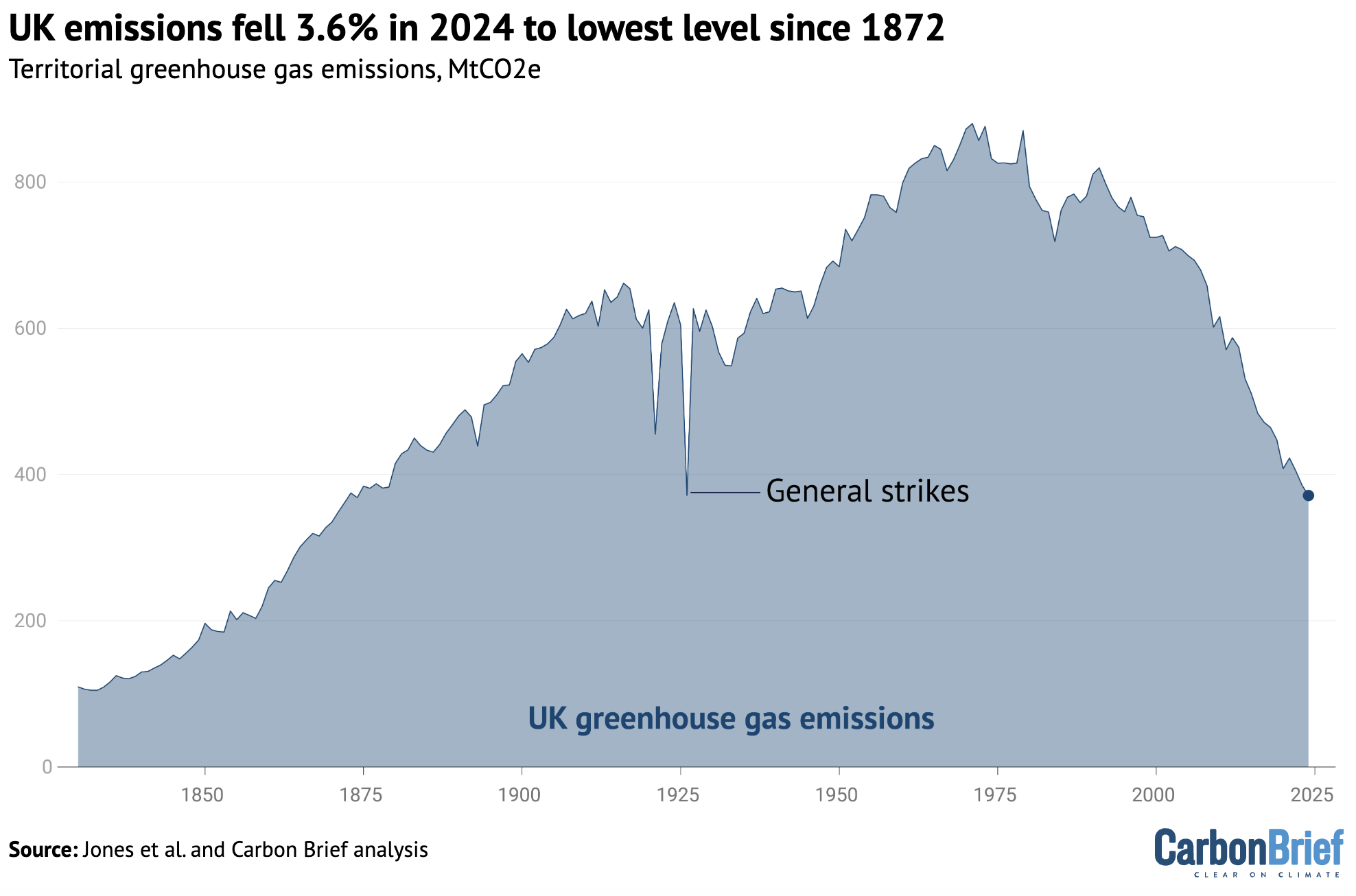
Das Ziel ist aber in GB wie in der EU inzwischen 0 Treibhausgasemissionen bis 2050 - cows inclusive. Um das zu erreichen, würde selbst die enorm schnelle Reduktion der letzten Jahre nicht ausreichen.
2-mal bearbeitet. Zuletzt am 18. februar 2026 09:25.
28-seitiger Bericht vom März 2025: [assets.publishing.service.gov.uk]
"27 March 2025 Accredited Official Statistics
In 2024, total UK net territorial greenhouse gas emissions are provisionally estimated to have
been 371 million tonnes of carbon dioxide equivalent (MtCO2e), a decrease of 4% from the
2023 estimate of 385 MtCO2e. Emissions were 54% lower than they were in 1990. Carbon
dioxide made up around 78% of the 2024 total.
Between 1990 and 2024, emissions decreased by 54%. The largest factor behind this long-
term decrease was the change in the mix of fuels being used for electricity generation, with a
shift away first from coal to gas in the 1990s, and more recently to renewable energy sources.
Since 1990, emissions from coal use have decreased by 98%. Over the same period, gas and
petroleum use emissions have decreased by 5% and 35% respectively, but have increased as
a share of UK emissions since emissions from other sources have fallen more quickly."
Damit ist etwa das Emissionsniveau der 1870er Jahre erreicht: [www.carbonbrief.org]
Das Ziel ist aber in GB wie in der EU inzwischen 0 Treibhausgasemissionen bis 2050 - cows inclusive. Um das zu erreichen, würde selbst die enorm schnelle Reduktion der letzten Jahre nicht ausreichen.
2-mal bearbeitet. Zuletzt am 18. februar 2026 09:25.
| Thema | Klicks | geschrieben von | Datum/Zeit |
|---|---|---|---|
 Briten wollen bis 2050 60% Emissionsminderung erreichen |
739 | Peter Tobies | 27.11.07 01:01 |
|
Aktuell (2024) sind es 54 % weniger als 1990 (Kohle -98 %, Öl -35 %, Gas -5 %)
|
155 | Badischer Reisbauer | 18. Februar 2026 09:14 |
In diesem Forum dürfen leider nur registrierte Teilnehmer schreiben.